Khizar Seo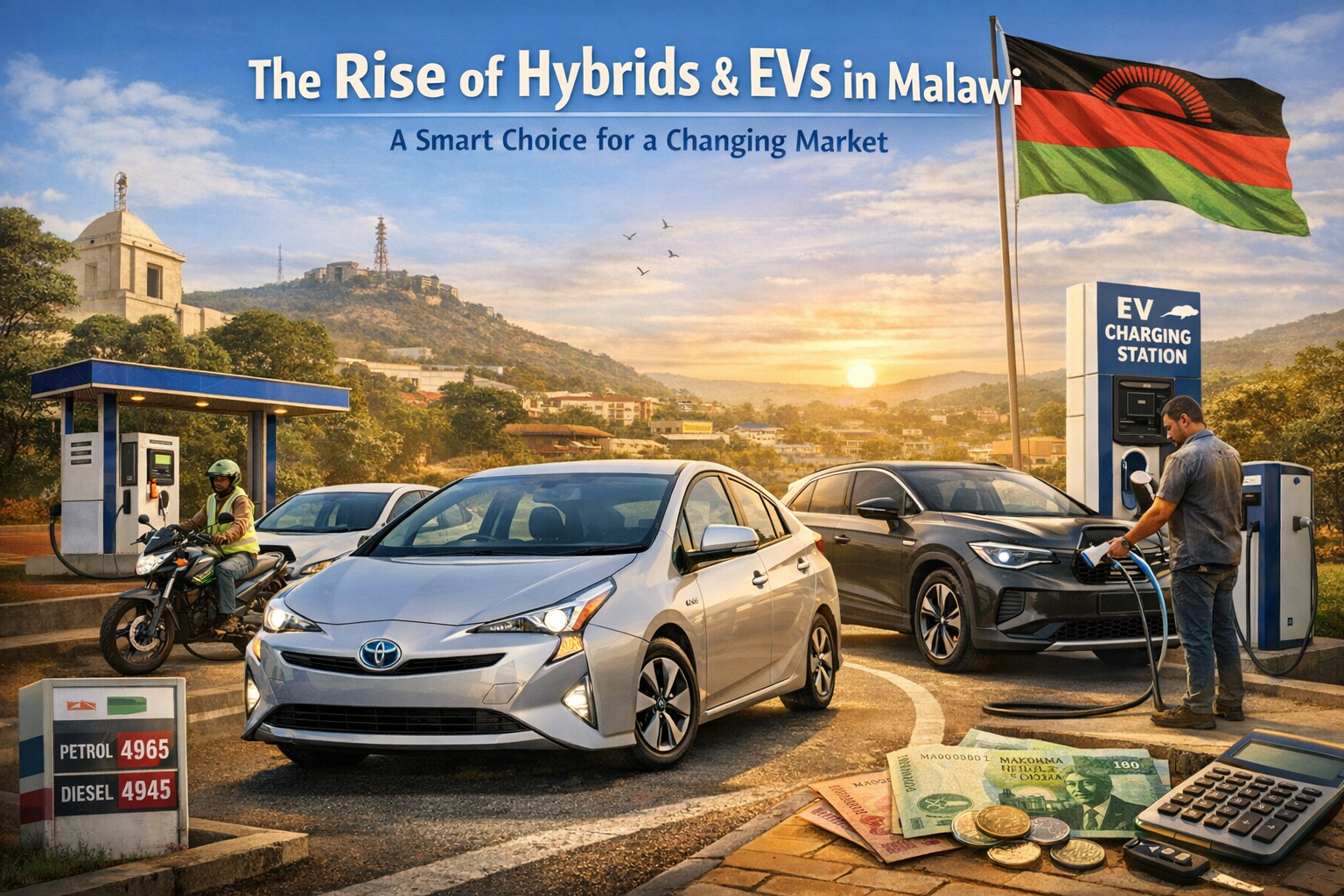
For a long time, hybrid and electric vehicles felt like something for bigger, more mature markets. In Malawi, that is beginning to change. The country is still in the early stages of e-mobility adoption, but the direction is becoming clearer: fuel is expensive, policy support for cleaner vehicles is real, and official government reporting now says Malawi has registered more than 30 electric vehicles and 280 electric motorcycles, alongside four motorcycle charging stations built through a partnership between SVG and TotalEnergies. That is not a mass-market transition yet, but it is enough to show that hybrids and EVs are no longer just theoretical ideas in Malawi.
That growing relevance is also visible in public policy. Malawi’s 2026–27 Budget Policy Statement says that fully electric motor vehicles and hybrid vehicles are currently exempt from import duty and excise tax, while also announcing a new excise tax for larger-capacity hybrids to further favor full EVs. In other words, the government has already been using the tax system to encourage cleaner transport, even as it fine-tunes how hybrids and EVs are treated differently.
Why Hybrids Make The Most Practical Sense For Many Malawian Buyers
For most buyers in Malawi today, hybrids are still the easier and more practical first step. A conventional hybrid does not need to be plugged in. Instead, it charges its battery through regenerative braking and the internal combustion engine, which means drivers still refuel in the normal way while benefiting from lower fuel use in traffic and slower-speed driving. That matters in a market where buyers want savings, but do not always want to depend on a charging setup or completely change their ownership routine.
The fuel-cost side of the equation is especially important. In January 2026, Reuters reported that Malawi raised petrol prices to 4,965 kwacha per litre and diesel to 4,945 kwacha per litre. When fuel sits at that level, efficiency stops being a nice extra and becomes a serious buying factor. That is where hybrids become easier to justify: they offer a more familiar ownership experience than a full EV, but still help reduce fuel consumption in everyday use.
Where Full EVs Already Make Sense
That does not mean EVs should be ignored. In the right use case, they already make a lot of sense. Buyers with predictable city driving, shorter daily distances, and dependable charging at home or work can still benefit from an EV’s quieter driving experience and lower routine maintenance needs. The U.S. Department of Energy’s Alternative Fuels Data Center notes that EVs generally have fewer moving parts, fewer fluids to change, and less brake wear because regenerative braking does more of the slowing work.
The key is to stay realistic about Malawi’s current stage. Official reporting shows progress, but it also shows a market that is still developing rather than fully built out. Malawi’s 2026 Annual Economic Report points to over 30 EVs, 280 electric motorcycles, four motorcycle charging stations, and a national e-mobility regulatory framework under development. UNDP Malawi’s 2024 EV launch also signaled growing institutional support for cleaner transport. So the right conclusion is not that EVs are already easy for everyone, but that they are becoming more viable for the right buyer profile.
The Kinds Of Vehicles That Make The Most Sense To Consider
For buyers looking at hybrids, a few Japanese models stand out because they combine efficiency with proven practicality. The Toyota Prius remains a benchmark hybrid, with Toyota’s current Prius using a 2.0-litre hybrid system with up to 196 net combined horsepower. The Toyota Aqua is attractive because Toyota built it around a compact 1.5-litre hybrid setup that prioritizes fuel economy and easy urban use. The Toyota Corolla Fielder Hybrid makes sense for buyers who need wagon practicality as well as efficiency, with Toyota saying it offers 407 litres of luggage space with five passengers and 872 litres with two. Honda’s Fit e: HEV is also a strong example of why compact hybrids appeal, because Honda emphasizes both comfortable seating and versatile seat arrangements in a small footprint. These are the kinds of vehicles that suit buyers who want lower running costs without giving up everyday usefulness.
On the EV side, the Nissan Leaf remains one of the easiest used EVs to understand and recommend because it has been on the market long enough to feel familiar, and Nissan’s recent Leaf materials still center the car around practical battery options and usable everyday range. For buyers who want something more premium, models like the Volkswagen ID.4 show what a modern electric SUV can offer, with Volkswagen currently quoting up to 291 miles of EPA-estimated range for the ID.4 Pro. In Malawi, though, the smartest approach is not to chase the most advanced badge. It is to choose the vehicle that best matches your route, charging access, and long-term budget.
What Buyers Should Keep In Mind Before Importing
The biggest mistake buyers can make is assuming every hybrid or EV will suit them equally well. In Malawi, the better approach is to think practically. How far do you drive each day? Will the car mostly stay in Lilongwe or Blantyre, or will it regularly cover longer intercity routes? Do you have reliable charging access if you are considering a full EV? And if you are buying a hybrid, what engine size does it have, given the government’s announced excise changes for larger-capacity hybrids? These are the details that matter more than hype.
Why Carbarn Malawi Matters In This Conversation
This is exactly where Carbarn Malawi can make a real difference. Choosing a hybrid or EV is not only about finding a car that looks modern or promises lower running costs. It is about choosing the right vehicle for Malawian roads, Malawian budgets, and real-world daily use. Carbarn Malawi can help buyers make that choice with more clarity by focusing on suitable Japanese vehicles, practical ownership value, and a smoother import journey. For someone who wants the savings of a hybrid, the potential of an EV, and the confidence of working with a team that understands what local buyers actually need, Carbarn Malawi is the kind of brand worth paying attention to.
Hybrids and EVs are not replacing every petrol or diesel car in Malawi overnight. But they are becoming much more relevant than they used to be. High fuel prices, tax policy support, and the first visible signs of an e-mobility ecosystem have all made cleaner vehicles easier to take seriously. For many buyers, hybrids are the strongest near-term option because they are efficient without being disruptive. For others, especially drivers with predictable city use and reliable charging, EVs are starting to make genuine sense too. That is why this is no longer just a future conversation for Malawi. It is becoming a practical buying conversation right now.