Sky Bloom IT
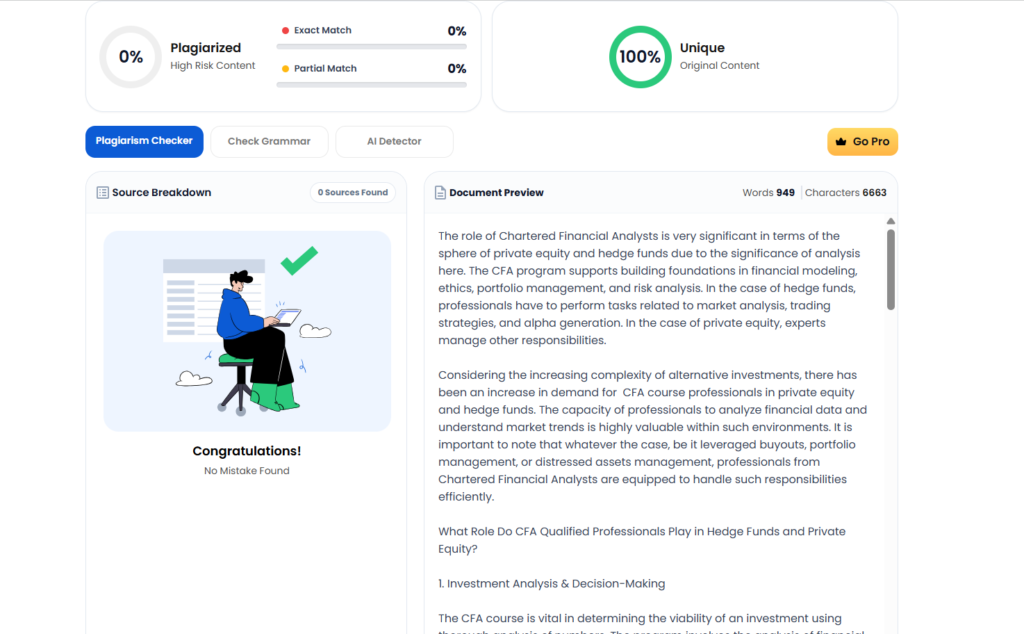
The role of Chartered Financial Analysts is very significant in terms of the sphere of private equity and hedge funds due to the significance of analysis here. The CFA program supports building foundations in financial modeling, ethics, portfolio management, and risk analysis. In the case of hedge funds, professionals have to perform tasks related to market analysis, trading strategies, and alpha generation. In the case of private equity, experts manage other responsibilities.
Considering the increasing complexity of alternative investments, there has been an increase in demand for CFA course professionals in private equity and hedge funds. The capacity of professionals to analyze financial data and understand market trends is highly valuable within such environments. It is important to note that whatever the case, be it leveraged buyouts, portfolio management, or distressed assets management, professionals from Chartered Financial Analysts are equipped to handle such responsibilities efficiently.
What Role Do CFA Qualified Professionals Play in Hedge Funds and Private Equity?
1. Investment Analysis & Decision-Making
The CFA course is vital in determining the viability of an investment using thorough analysis of numbers. The program involves the analysis of financial statements, macro-economics, and industries for the purposes of identifying under-valued stocks and/or high growth stocks. An understanding of how valuation techniques such as discounted cash flow analysis, scenario analysis, and comparable companies valuations can assist corporations in making the right decisions.
These skills will be useful in determining the value of the readily marketable instruments such as equities and derivatives for a hedge fund and non-marketable securities for private equity funds of private organizations. Every decision will be made according to the strategy of the fund.
2. Portfolio Management & Strategy Execution
The CFA designation includes the construction and management of portfolios! This means that the professionals always ensure the best possible allocation, which is in line with the objectives of the fund, and the diversity of assets. Using their understanding of the risks and rewards, these professionals keep on rebalancing the portfolios in order to maximize the gains while minimizing the risks.
Portfolios managed by hedge funds can adopt complex management techniques such as long-short equities, international macroeconomic, and arbitrage techniques. For private equity, it requires portfolio company management.
3. Financial Modelling & Valuation Expertise
One of the key skill sets of CFA course professionals is advanced financial modelling! Hedge funds create models that forecast organizational performance, evaluate investment scenarios, and determine intrinsic value. It becomes even more important in private equity, where investments have lower liquidity and require accurate assumptions regarding their valuations.
In hedge funds, modelling helps identify short-term mispricing opportunities and stress-test strategies under dynamic market conditions. Their ability to interpret complex financial data and convert it into actionable insights is a major asset in both industries worldwide.
4. Risk Management & Compliance
Risk management is at the core of hedge funds and private equity operations, and Chartered Financial Analyst professionals are trained to identify, measure and combat varied risks. These involve market risk, credit risk, operational risk and liquidity risk. Moreover, they rely on quantitative approaches and methodologies to ensure that the portfolio stays within the acceptable risk level.
Furthermore, Chartered Financial Analyst designation holders follow an ethical code of conduct, which is vital in complying with regulations. In a strictly regulated world, the candidate’s knowledge about governance and accountability would safeguard not only the organization but also its investors.
5. Due Diligence & Deal Structuring
In the case of private equity, professionals from CFA course have been seen to engage in the process of performing due diligence before making an investment decision. The above process has involved evaluating the finances, management, operations, and market status of the targeted firm.
The professionals are engaged in the process of structuring deals, which assists in identifying the best ways of financing the deal, the exit strategy, and the ownership ratio. When it comes to hedge funds, professionals perform due diligence in evaluating counterparts or new strategies.
6. Performance Monitoring & Reporting
After having invested in companies, Chartered Financial Analysts monitor the progress of their investments relative to expectations. This is done through measuring KPIs, analyzing variances, and giving suggestions on optimizing their returns.
Professional Chartered Financial Analysts are significant players in the investor reporting process where reports are drafted with an intention of communicating risks and performance.
7. Market Research & Macro Insights
Chartered Financial Analysts remain up to date with market trends through regular research on economics, financial markets and industry dynamics. They understand very well the macroeconomic environment in terms of interest rates and politics, which helps the fund anticipate market trends.
This knowledge plays an important role in making strategic trades in hedge funds but long-term investments in private equity.Their research-based approach makes sure that the investment decisions are reactive and also proactive and forward-looking.
Conclusion
The CFA professionals play a vital role in hedge funds and private equity by combining financial analysis, strategic decision-making and risk management to drive investment outcomes. Their knowledge enhances the performance of their portfolios and boosts investors’ confidence in an extremely complicated finance environment.
If you aspire to establish yourself as a professional in such fast-growing industries, take the first step on this path with Zell Education.
FAQs
1. What is the role played by Chartered Financial Analyst practitioners in hedge funds?
Market assessment, portfolio management, and investment techniques are employed in order to create optimal returns.
2. How can CFA practitioners be involved in private equity firms?
These professionals perform analysis of investments, perform due diligence, and assist in deal making and exits.
3. What skill sets can Chartered Financial Analysts offer to these areas?
Financial modeling, portfolio management, analytics, and strategy can be included in their skills set.
____________________________________________________________________________
Quillbot Report
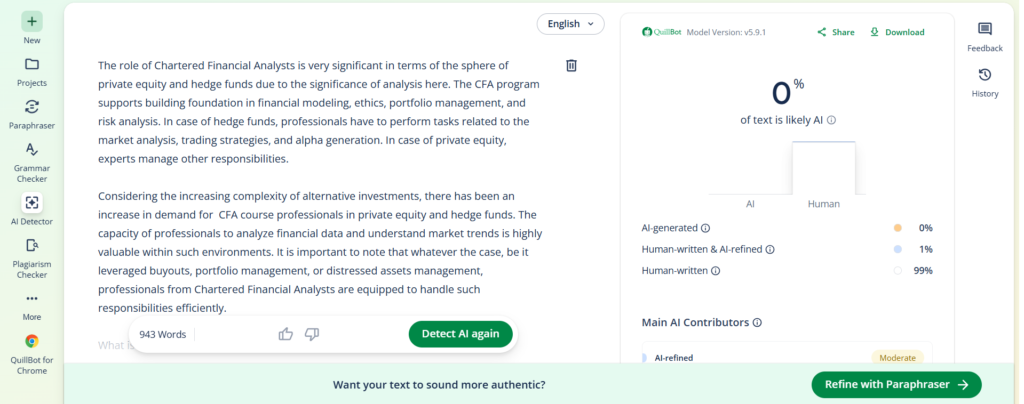
Plagiarism Report