HoneyLinkers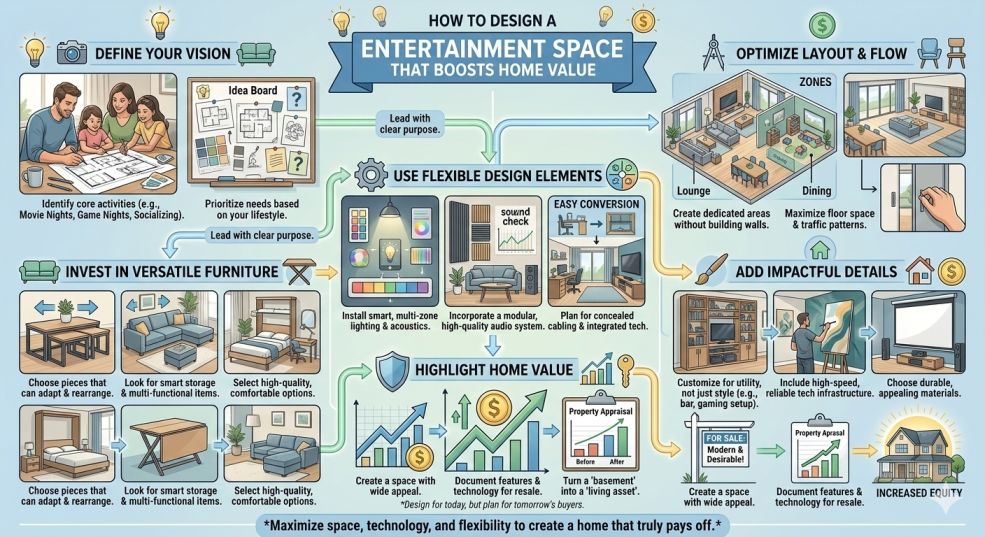
You want a room that feels like “finally, we use this space,” not a weird man-cave museum that future buyers side-eye and mentally price out in demolition costs. That’s the whole game.
When you’re stuck on what actually works, steal proven layouts and feature combos from people who build these rooms for a living, this collection of basement game room ideas is a solid sanity-check before you start buying arcade machines and pretending you’ll “figure out the wiring later.”
Start with a Value-First Plan (Not a Pinterest Mood Board)
A multi-purpose entertainment space boosts home value when it reads as a finished, flexible “rec room + media lounge” instead of a single-use shrine to your hobbies, because buyers pay for square footage they can imagine using. Keep it adaptable. Keep it clean.
Over-customizing is real.
The simplest “value stack” that buyers recognize
- Comfort: good lighting, decent ceiling height treatment, warm flooring, no basement smell.
- Function: zones that make sense, storage that hides the mess, outlets where humans actually sit.
- Finish quality: trim, doors, consistent flooring, proper moisture management (yeah, boring, also expensive to fix).
If you’re choosing between “custom neon sign wall” and “built-in storage + lighting plan,” pick the storage and lighting every time, because buyers will use that on day one and your neon wall is… your neon wall.
Be honest.
Zone the Room Like You’re Running Traffic Control
Most entertainment rooms feel cramped because people try to cram everything into the middle, then wonder why the pool cue hits the wall while someone’s knees collide with the sectional. Design wants lanes. Humans want space.
So give it lanes.
The 3 zones that almost always work
- Screen zone: TV or projector, seating, speakers, lighting control.
- Play zone: table games, console wall, arcade row, board-game table, whatever your “activity” is.
- Support zone: bar/snack station, storage, mini fridge, coats/bags, and the stuff nobody wants to look at.
Here’s the slightly annoying truth: if you can’t describe your room in zones, you’re probably designing a clutter pile with a sofa in it, and that’s not the resale-friendly “finished basement” vibe you’re paying for.
Name the zones. Draw them.
Clearance math (a.k.a. the part everyone skips)
Pool tables and ping pong tables are space bullies, and the room needs to obey them, not the other way around, so measure first, then buy, not “buy and manifest.” A buyer won’t care that the table is brand new if it plays like a phone booth.
- Pool table: plan for the table size plus cue clearance on all sides (your walls will thank you).
- Ping pong: you need room behind the end lines, not just on the sides, or it’s basically decorative.
- Walkways: keep a clear path to seating, bathroom, stairs, and exits so the room doesn’t feel like an obstacle course.
And if your basement has posts, bulkheads, or that one mechanical corner that ruins your dreams, don’t fight it, use it to split zones or hide storage, because “pretending it’s not there” never looks intentional.
Make the weird stuff useful.
Pick One “Anchor Attraction” (Then Stop)
The fastest way to make the room feel expensive (and buyer-friendly) is to choose one main attraction and support it properly, instead of doing five things poorly with cables everywhere and furniture that blocks half the room. Think: one star, three strong supporting actors.
Limit the chaos.
Anchor options with good resale energy
- Media lounge: big TV or projector + comfy seating + real lighting control.
- Game table: pool or shuffleboard, with storage for cues/pucks and a path around it.
- Social bar corner: modest built-in or furniture-style bar, not a full nightclub situation.
VR zones are cool, sure, but the resale angle is “open space that could be a gym/office/guest area,” not “this corner only works if you punch the air twice a week.” Keep it flexible.
Flexibility sells.
Home Theater Meets Game Room: Don’t Let Them Compete
A screen zone and a play zone can absolutely live together, but you have to stop them from stepping on each other, glare ruins screens, loud speakers ruin conversation, and random arcade LEDs make movie night feel like you’re watching Netflix inside a vending machine.
Separate the vibes.
TV vs projector (quick, practical)
- Big TV: bright rooms, less fuss, cleaner install, great for mixed use.
- Projector: big wow factor, needs light control, needs planning for wires and mounting.
If you’re chasing ROI, a large TV with a tidy built-in and proper wiring often wins, because it looks turnkey and buyers don’t have to inherit your ceiling-mounted science project.
Simple reads as “done.”
Sound: make it fun for you, tolerable for everyone else
Bass travels. So do complaints. If you’re in a semi-detached or townhouse, untreated sound is a fast track to living like you’re wearing headphones in your own home.
- Solid-core door at the basement stairs helps more than people expect.
- Insulation in ceiling cavities cuts the bite.
- Acoustic panels (nice-looking ones) reduce echo and make the room feel “finished,” not boomy.
Don’t overthink it. Just don’t ignore it.
Lighting: The Cheat Code for “Wow” Without Going Broke
Lighting is where amateur rooms die, because someone tosses in six pot lights and calls it a day, then wonders why the TV has glare and the poker table feels like an interrogation. You want layers, ambient, task, accent, so the room can act like a room instead of a warehouse.
Dimmers are non-negotiable.
A layered plan that plays nice with resale
- Ambient: recessed or surface fixtures on a dimmer (warm temperature, not dentist-office white).
- Task: pendant or focused fixture above a game table or bar counter.
- Accent: LED strips in shelving, wall washers, or sconces for mood (easy to swap later).
Want smart controls? Fine. Just make sure the room still works with a normal switch, because buyers don’t want to download an app to turn on the lights.
They really don’t.
Flooring That Survives Real Life (and Basement Reality)
Basements are moody. They get damp, they get cold, and they punish “pretty” materials that weren’t chosen for below-grade life, so pick flooring like you’re planning for spills, a dropped cue ball, and a wet winter boot parade.
Choose durability over drama.
Common winners
- LVP (luxury vinyl plank): tough, moisture-friendly, easy to replace a section if something goes sideways.
- Carpet tiles: surprisingly practical in a play zone, warm underfoot, replace-one-not-all when someone dumps nachos.
- Engineered wood: can work with the right subfloor system, but don’t treat it like a ground-level living room.
If you’re adding heavy stuff, arcade machines, a pool table, a big sectional, think about dents, leveling, and moving paths now, not after your floor looks like it fought a war.
Heavy things leave scars.
Moisture, Air, and That “Basement Smell” Nobody Wants
This is the unsexy part that makes resale happen: if your basement feels dry, smells neutral, and holds temperature like the rest of the house, buyers relax, and relaxed buyers pay more. If it smells like damp concrete and old hockey gear, they start calculating headaches.
Fix air first.
Baseline checklist before you finish anything
- Humidity: run a dehumidifier if you need it, and don’t pretend you don’t.
- Waterproofing/drainage: deal with leaks, damp walls, and floor seepage before drywall and flooring.
- Ventilation: make sure the space actually gets supply/return air, especially if you’re packing it with people and electronics.
Electronics hate moisture. So does drywall. So do buyers.
Handle it early.
Electrical and Tech: Hide the Mess Like a Grown-Up
A modern entertainment room is basically a power-hungry cave full of screens, consoles, routers, powered speakers, chargers, mini fridges, and whatever else you’ve added since last Tuesday, so plan circuits and outlets upfront or you’ll end up with a spaghetti nightmare that screams “DIY weekend special.”
Wires kill vibes.
What to plan (without getting too nerdy)
- Dedicated circuits for big loads (theater gear, mini fridge, arcade row).
- Outlet placement where people sit, not just along baseboards behind furniture.
- Data: run ethernet if you can, or at least plan a mesh Wi‑Fi setup so streaming doesn’t stutter during the big game.
- Cable management: conduits, in-wall rated wiring, proper wall plates, clean, simple, future-proof-ish.
If you’re not confident with electrical, don’t wing it. That’s how “fun renovation” becomes “insurance conversation.”
Pay the pro.
Storage and Built-Ins: The Quiet ROI Move
Storage is what keeps a multi-purpose room from turning into a dumping ground, and buyers notice it immediately because they’re already imagining Christmas decorations, sports gear, board games, and the random stuff that migrates downstairs forever.
Hide the clutter.
Storage ideas that don’t feel like a garage
- Closed cabinetry for controllers, games, and cables (nobody wants to see the tangle).
- Built-in bench with lift-up storage under windows or along a wall.
- Tall cabinet for cue sticks, darts supplies, and “small chaos.”
A bar/snack station helps too, even if it’s simple: counter, a spot for a microwave, maybe a drink fridge, and drawers that swallow mess. That reads as lifestyle. Buyers pay for lifestyle.
They always have.
Themes That Sell (Without Trapping You in One Look)
Theme is fine. Theme is fun. Theme can also date your house faster than you can say “industrial barnwood gamer den,” so keep the permanent finishes neutral and run your theme through swappable stuff, paint accents, art, neon signs, stools, pillows, whatever.
Permanent = neutral.
Resale-friendly theme approach
- Walls/floors/ceiling: timeless, light-to-mid neutrals, consistent materials.
- Personality: decor, posters, LED accents, a feature wall you can repaint in a day.
- Furniture: modern shapes, durable fabrics, nothing too weirdly specific.
If you want “sports bar basement,” do it with framed jerseys, a decent bar cart, and a TV wall, not a permanent logo mural that only makes sense if the next owner loves your team.
Keep it removable.
Spend vs Save (So ROI Doesn’t Get Weird)
Every entertainment space has a budget moment where you think, “Maybe I should just buy the fancy thing,” and sometimes you should, but not when the basics aren’t handled, because resale doesn’t reward flashy gadgets sitting inside a mediocre finish.
Finish beats toys.
Spend here
- Moisture management (waterproofing, dehumidification plan).
- Electrical planning (circuits, outlet locations, safe installs).
- Lighting (layers + dimmers).
- Storage/built-ins (even partial built-ins go a long way).
Save here
- Decor (theme stuff should be cheap to swap).
- Furniture (go modular and decent, not precious).
- “Smart” extras (nice, but don’t let gadgets replace good design).
And yes, plumbing for a full wet bar or basement bathroom can bump value, but only if the rest of the basement feels properly finished, otherwise it’s lipstick on a damp pig.
Harsh. True.
DIY vs Contractor: Where People Get Burned
Painting, swapping light fixtures (safely), assembling furniture, hanging panels, go for it if you’re handy. But waterproofing, electrical upgrades, framing around mechanicals, and anything permit-related in Ontario is where DIY confidence turns into expensive backtracking.
Know your limits.
- DIY-friendly: decor, furniture, some flooring (depending), storage systems, acoustic panels.
- Pro territory: electrical load planning, new circuits, plumbing rough-ins, structural changes, egress windows, code compliance.
If you’re in Toronto/GTA, buyers and inspectors aren’t shy, and “creative wiring” or mystery framing is a classic deal-killer during negotiation.
Don’t gift-wrap problems.
The Mistakes That Quietly Kill Home Value
Most value loss doesn’t come from choosing the wrong style; it comes from choices that make the space feel lower-quality, harder to maintain, or impossible to repurpose, which is exactly what buyers fear about finished basements.
- No moisture plan (you finished over a problem).
- Bad lighting (the room feels cave-like or glaring).
- Overbuilt theme (can’t easily repaint or reconfigure).
- Cluttered layout (no circulation, no clear zones).
- Visible wires (reads unfinished, always).
If you avoid those five, you’re already ahead of a lot of “finished” basements on the market.
Seriously.
Design It Like a Buyer Will Live There (Because One Day, They Will)
A multi-purpose entertainment space that boosts home value doesn’t need to be fancy; it needs to feel intentional, dry, comfortable, and flexible, with clean tech and storage so the room looks like bonus square footage, not a messy experiment. Build a space you’ll actually use now, while quietly making it easy for someone else to love later.
That’s the win.