Qamer Javed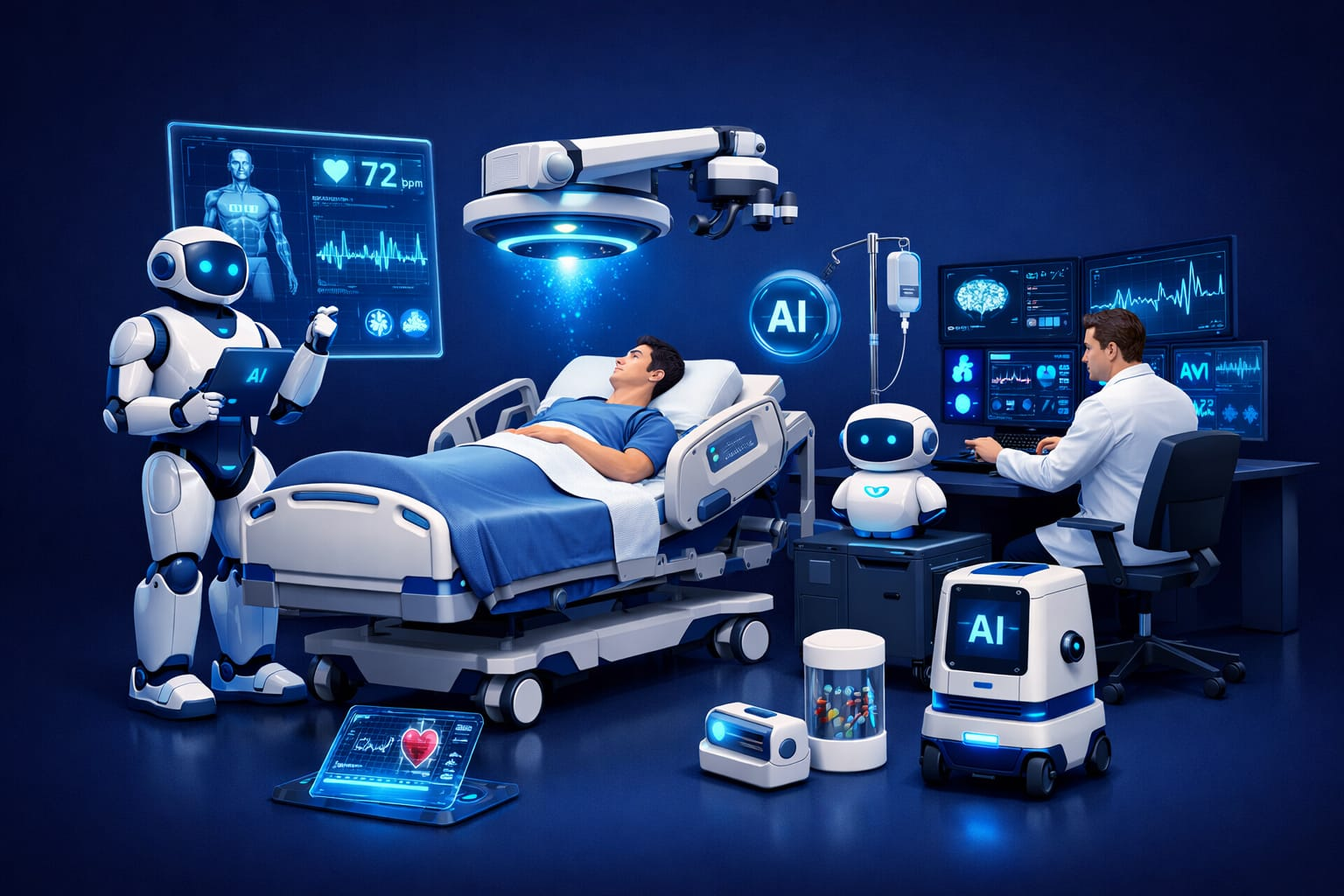
Hospitals today are always overloaded with data, including images, lab results, physicians’ notes, insurance formats, and device needs. Human staff alone can’t absorb it all. That’s where AI in hospital caresteps into the picture. It sits in the centre of the biggest healthcare shift, amidst staff shortages, overrated administrative tasks, and rising patient expectations.
Acting like your digital colleague, AI can sift mountains of information, highlight what matters, and free professionals to focus on the human side of care. And as the global AI in healthcare market is heading towards $110.61 billion by 2030, the dependence on robust AI intelligence networks will only deepen.
So, with the new year just around the corner, let’s understand how AI in healthcare 2026 will take shape.
What AI in Hospital Care Really Means in 2026?
By 2026, hospitals will be driven by advanced AI models and techniques, such as generative AI in healthcare, machine learning models, natural language processing, computer vision, and real-time analytics. These technologies will work together to analyze and process large volumes of clinical and operational data into actionable insights.
Unlike the earlier healthcare AI tools that worked only on rule-based algorithms, modern AI systems integrate smart hospital technologies that learn from outcomes, align with hospitals’ unique workflows, and integrate seamlessly into EHRs or clinical systems. However, the performance of these advanced systems greatly depends on the AI development service provider in terms of how much it understands domain-specific requirements and healthcare data.
In terms of capabilities, AI can transform different functions across the hospitals, such as emergency medicine services, ICUs, revenue cycle operations, and outpatient services etc. Instead of working as isolated units, AI allows these departments to work in coordination as a connected unit.
Top Ways AI Will Transform Patient Care in 2026
Even the best doctor has to deal with limits. There’s too much data, too many patients, but not enough time. That’s where the need for AI hospital automationemerges.
Here are the top AI healthcare trends that will quietly transform patient care in 2026:
AI-Powered Early Diagnosis & Predictive Risk Alerts: AI models can analyze patient data to find patterns linked to specific diseases like diabetes, cancer, or heart conditions. The use of such predictive analytics allows healthcare professionals to assess individual risk and intervene early with tailored treatment plans.
Personalized Treatment Plans Using AI Modeling: AI in healthcaresynthesizes data like genomics, lifestyle behavior, and medical history to offer customized treatment strategies for each patient. This way, you can ensure relevant medical interventions with fewer side effects based on personal health needs.
AI-Enhanced Radiology & Image Interpretation: AI algorithms can process X-rays, CT scans, MRIs, and MRI scans with high speed and precision. The system is trained to detect patterns and subtle anomalies to support radiologists in finding conditions that might be missed.
Smart ICU & Remote Patient Monitoring: Artificial intelligence-based solutions monitor and analyze patient health data from vital signs as well as wearables. As soon as the data varies from expected trends, it notifies them to quickly respond to prevent any unpleasant situations.
Virtual Nursing Assistants & AI Care Navigation: Voice-enabled assistant or virtual nursing assistant can guide patients through care instructions provided by the doctor, answer common patient queries, provide personalized answers, and escalate concerns in case of emergency.
How AI Will Transform Hospital Operations & Administration
AI for clinical practices runs in the background, performing operations, logistics, and administration:
AI Automation Scheduling & Billing, & Claims: AI-powered RPA assists with routine work such as billing, insurance claims, and recording of transcriptions. Similarly, integrating anAI Medical Scribe Software for hospitals can automatically perform clinical conversations into structured notes. Hospitals working with experienced AI development companies often prioritize automating these workflows to accelerate ROI.
Smart Resource and Bed Management Systems: AI-based capacity planning toolscan provide predictions for patient admissions, discharges, and resource requirements in real-time. Such capabilities can help in optimizing bed utilization, especially in emergencies.
AI-Driven Supply Chain and Inventory Optimization: AI-powered predictive inventory systems can scan through the historical usage patterns of the supplies and prevent overstocking or manage procurement on schedule.
Challenges to Overcome Before Full Adoption of AI
In spite of the above advantages, the trends that relate to AI healthcare also have various challenges:
- Data Privacy & Security: Patient data is the most protected file among the following. AI should comply with the specific rules and industry standards, such as HIPAA and GDPR, to ensure data privacy and security.
- Bias and Fairness: If AI training data sets lack diversity, the AI system might produce biased or unreliable results. Thus, diverse data validation is required for data correctness. Every aspect of a project must have a risk strategy.
- Clear Explainability and Trust: Most AI systems operate as “black boxes,” making it difficult for doctors and hospital staff to understand how decisions and recommendations are generated. Thus, healthcare organizations can adopt explainable AI models that efficiently outline the reasoning behind predictions.
- Workflow Fit: If a tool takes five new clicks for logging each time, this is likely not going to mesh well with the current workflow. Integration with EHR for Single Sign On is an asset in this case.
- Culture and Skills: Employees could worry about losing their jobs, and others may not trust technology. Training and change management initiatives must be invested in so that they can adjust to the innovation.
Conclusion
The future of patient care in hospitals is undoubtedly intertwined with AI advancements. As AI continues to evolve and integrate into healthcare, you can look forward to patient care that is more personalized, efficient, and effective than ever before. But to keep this progress going, you need professionals who can help you at the forefront of this revolution.
Partnering with a reliable AI development company can make all the difference in the healthcare domain. Its end-to-end AI development services can enhance patient care, streamline and automate your everyday operations, all while reducing costs and making healthcare more accessible.
FAQs
How will AI impact hospitals in 2026?
AI will positively impact hospitals by making patient care more personalized, predictive, and efficient in 2026. It will enable continued remote monitoring and automate admin tasks to ensure better outcomes at a lower cost.
Will AI replace doctors?
No, AI will not replace doctors. In fact, it is creating new roles and helping healthcare professionals to focus more on patient care.
What medical tasks can AI perform safely?
AI can perform different medical tasks without any hassles, such as medical image analysis, early disease detection, risk prediction, clinical decision support, and remote patient monitoring with personalized assistance.
Are AI-powered hospitals more accurate?
AI-powered hospitals are considered to have smart systems with added potential for better diagnostic accuracy and reduced human errors. It assists human professionals in handling high-volume tasks; however, if it is not trained properly for bias and fairness, the AI systems might produce inaccurate results.
How much does AI implementation cost?
The cost for AI implementation may vary based on several factors, including the size of your facility, workflow requirements, and the complexity of the project. Make sure to assess your facility and request a demo to plan your budget.