HoneyLinkers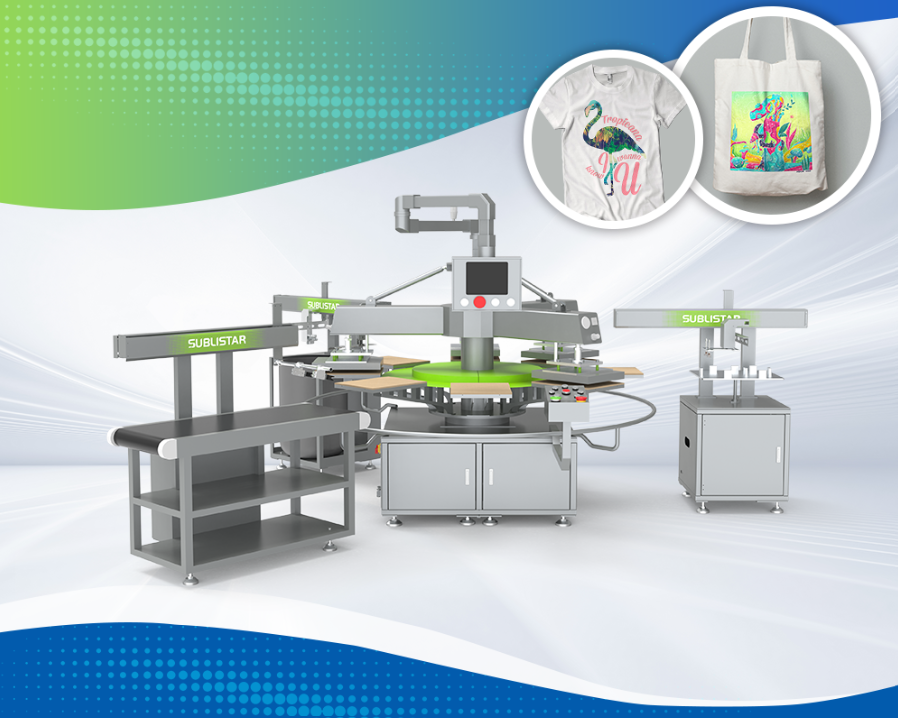
When order volumes climb, labor costs stack up, and inconsistent results start slipping through quality control, the limitations of manual pressing become hard to ignore. That’s where automated heat press machines come in.
But who actually needs one? Automation isn’t the right fit for every operation. This post will introduce who will benefit most from an automated heat press machine.
High-Volume Print Shops
If your shop is running hundreds—or thousands—of garments per day, manual pressing creates a serious bottleneck. An automated system like the Sublistar X-PRESS V6.0 8-station automated heat press machine can process up to 360 pieces per hour, running continuously with minimal operator involvement. That kind of throughput is simply out of reach for manual setups.
For shops operating on tight turnarounds or 24/7 production schedules, automation also removes the dependency on skilled operators being present at every step. The machine handles loading, pressing, cooling, film peeling, and unloading in a continuous sequence—so output stays consistent regardless of who’s on shift.
Print-on-Demand (POD) Businesses
POD businesses face a unique challenge: high variety at high volume. Orders are often one-off or small-batch, but they still need to be turned around quickly and accurately.
Automated heat press machines address this directly. Features like preset template support let operators save pressing parameters—temperature, time, film position—and recall them instantly for repeat jobs or new SKUs. Flexible operation modes (automatic, semi-automatic, and manual) mean the machine adapts to different production scenarios without requiring a full reconfiguration each time.
For POD operations servicing global e-commerce clients, this kind of agility is essential.
Custom Apparel Brands With Multi-Position Designs
Brands producing garments with multiple transfer placements—a chest logo, a back graphic, a sleeve detail—know how time-consuming manual alignment can be. Each placement requires precise positioning, and mistakes mean reprints.
Automated systems with vision-guided film peeling and multi-pattern processing capabilities remove much of this friction. The X-PRESS V6.0, for example, can handle up to three transfer films on a single garment in one pressing cycle, with dual cameras detecting film position accurately even for off-center or edge placements. That’s a significant time saving per unit, multiplied across thousands of orders.
Contract Manufacturers Scaling Operations
Contract manufacturers often work with fluctuating order volumes and diverse client requirements. One week it’s lightweight cotton tees; the next it’s heavier fleece hoodies. Manual setups struggle to adapt quickly.
Automated heat press machines with adaptive garment gripping systems handle varying fabric thicknesses without manual adjustment. Combined with programmable controls and smart error-skip functionality—which lets operators bypass a problematic station without halting the entire line—these machines keep production moving even when issues arise.
Factories Looking to Reduce Labor Costs
Labor is one of the highest operational costs in garment decoration. Repetitive tasks like film peeling, garment loading, and unloading are prime candidates for automation, not because workers can’t do them, but because automating them frees people up for higher-value work.
Reduced reliance on manual labor also means fewer errors tied to fatigue or inconsistency across shifts. For factories prioritizing workforce efficiency and long-term cost control, automated heat pressing offers a clear return.
Is an Automated Heat Press Right for You?
The short answer: if you’re processing high volumes, managing complex multi-position designs, running a POD fulfillment operation, or looking to scale without proportionally increasing headcount, an automated heat press machine is worth serious consideration.
Smaller operations or those just starting out may find that a semi-automatic or entry-level automated option—like the DTF Lite Intelligent Automated Heat Press Carousel—offers a more accessible entry point before committing to a full industrial system.
Not sure which setup fits your workflow? Contact the industrial experts in SUBLISTAR, and they will recommend the best DTF printing solution for you.