Sky Bloom IT
Software supply chain security has gone from being a niche concern to a top board-level priority. Many modern apps depend heavily on open-source libraries, third-party components and nested dependencies that most teams don’t fully control or even see. When a serious vulnerability is disclosed, it can be hard for companies to quickly and accurately figure out its exposure.
This challenge is why more people are using SBOM. But generating an SBOM doesn’t automatically improve security. Many companies find that their SBOMs sit unused, are out of date, or do not help them make real decisions when incidents happen. The difference between success and failure lies in how SBOMs are implemented and managed.
This guide focuses on the SBOM best practices that help security and development teams turn SBOMs into a useful and operational security tool.
Why SBOM Programs Fail Without Best Practices
Some common failure patterns are:
- SBOMs generated once and never updated
- No clear ownership between development and security teams.
- SBOMs are seen as audit artefacts instead of living assets.
- No integration with vulnerability management
- Too much data with no prioritisation
Without strong SBOM practices, companies get visibility on paper, but there is little reduction in real risk.
Treat SBOMs as Living Artifacts, Not Static Files
One of the most important things to remember about SBOMs is that they are not documents. They are inventories that are continuously changing.
Software changes a lot because of:
- New feature releases
- Dependency updates
- Security patches
- Changes to the configuration
Good teams make sure that SBOMs are:
- Automatically regenerated with each build or release
- Versioned along with the software
- Updated when dependencies change
- Open to both development and security teams
Static SBOMs lose their usefulness and accuracy very quickly.
Integrate SBOM Generation into CI/CD Pipelines
Manual SBOM creation does not scale and introduces gaps.
Automation in CI/CD pipelines is a basic best practice for SBOMs. This makes sure:
- SBOMs show the actual deployed state
- No releases happen without updated component visibility
- Changes to dependencies are recorded immediately
- Security reviews are based on current data
Automation reduces friction for developers while improving trust in SBOM accuracy.
Capture Transitive Dependencies, Not Just Direct Ones
A lot of high-impact vulnerabilities start deep within dependency chains.
SBOM best practices say that teams must:
- Include both direct and indirect dependencies
- Understand dependency relationships
- Avoid focusing only on top-level libraries
Not capturing transitive dependencies gives a false sense of security and delays incident response when vulnerabilities appear deep in the stack.
Assign Clear Ownership for SBOM Accuracy & Action
One of the most overlooked SBOM best practices is ownership.
Effective programs define:
- Who is in charge of generating SBOM
- Who validates component accuracy
- Who deals with SBOM-defined vulnerabilities
- Who maintains SBOMs over time
Without ownership, SBOMs exist, but no one acts on them.
Connect SBOMs to Vulnerability Management Workflows
SBOMs are only useful when they help you respond to vulnerabilities faster and smarter.
Some good SBOM practices are:
- Linking SBOM data to information about vulnerabilities
- Mapping vulnerabilities to the apps that are affected
- Prioritising remediation based on exposure and usage
- Reducing manual impact analysis during disclosures
When SBOMs are isolated from vulnerability workflows, they become informational rather than actionable.
Use SBOMs to Support Risk-Based Prioritisation
Not every vulnerable component represents equal risk.
Mature SBOM best practices help teams figure out:
- Is the vulnerable component actually used?
- Is it exposed at runtime?
- Does it affect critical business functions?
By adding context, SBOMs help teams focus remediation where it matters most instead of reacting blindly to every alert.
Standardise SBOM Formats and Data Models
Different SBOM formats make it hard to analyse and combine data.
Some good SBOM best practices are:
- Using standard formats like SPDX or CycloneDX
- Normalising SBOM data across tools and teams
- Not using custom, ad-hoc SBOM structures
Standardisation enables automation, sharing and long-term scalability.
Make SBOMs Useful for More Than Just Security Teams
When developers see SBOM as a security burden, it often doesn’t work.
Effective SBOM practices ensure developers can:
- Easily understand the risks of every component
- Identify ownership of dependencies
- Make informed decisions during development
- Reduce technical debt over time
When developers see SBOMs as helpful rather than punitive, adoption improves dramatically.
Maintain SBOMs Across the Full Software Lifecycle
The responsibility for SBOM doesn’t end when it is deployed.
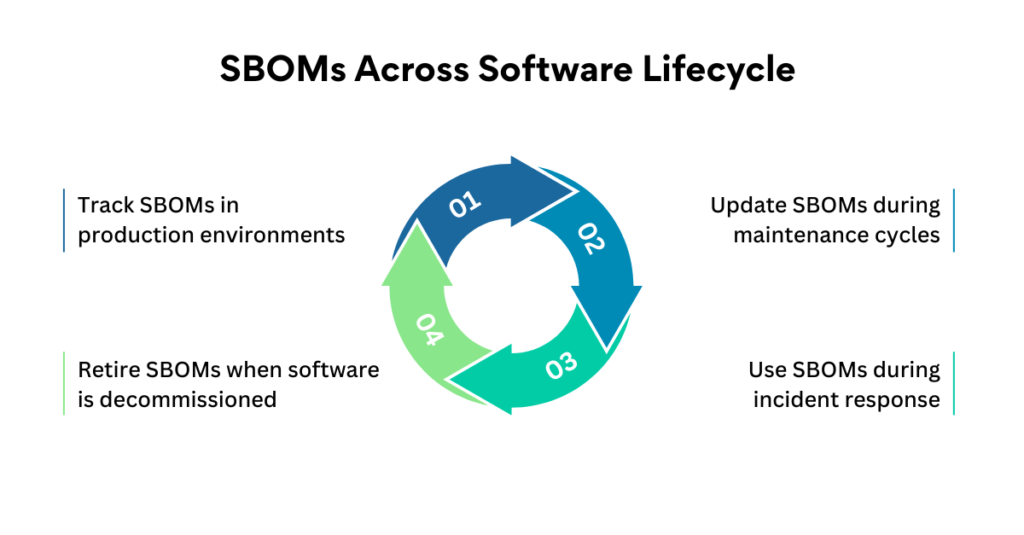
Best practices require teams to:
- Track SBOMs in production environments
- Update SBOMs during maintenance cycles
- Use SBOMs during incident response
- Retire SBOMs when software is decommissioned
Lifecycle management prevents blind spots as systems age.
Validate SBOM Accuracy Regularly
An inaccurate SBOM is worse than no SBOM.
Strong SBOM best practices include:
- Regularly checking the accuracy of SBOM data
- Cross-checking against runtime environments
- Reviewing discrepancies during assessments
- Updating SBOMs after architectural changes
Validation makes sure that teams trust the data when it matters most.
Common Mistakes to Avoid When Implementing SBOM Best Practices
Even well-intentioned teams make avoidable mistakes.
These are:
- Only using SBOMs as compliance deliverables
- Not paying attention to vendor and third-party SBOMs
- Failing to train teams on SBOM usage
- Overloading teams with raw SBOM data
- Not measuring SBOM effectiveness
For long-term success, it is important to avoid these pitfalls.
When SBOM Best Practices Become Critical
SBOM practices are especially important when organisations:
- Develop or distribute software products
- Depend heavily on open-source parts
- Work in regulated industries
- Manage large, complex application portfolios
- Face frequent vulnerability disclosures
In these situations, the level of SBOM maturity has a direct effect on security outcomes.
Conclusion
SBOM adoption alone doesn’t reduce risk – how SBOMs are implemented does. Security and development teams can see things more clearly, respond more quickly to vulnerabilities, and prioritise fixing them better when they follow strong SBOM best practices.
As software ecosystems get more complicated, scalable SBOM management solutions are becoming essential for visibility and speed. CyberNX is a reliable cybersecurity firm that can help you. They work alongside teams to implement solutions that align with real operational needs, not theoretical models. Organisations that treat SBOMs as living, operational assets will be far better prepared to manage supply chain risk and respond confidently to emerging threats.