2Q-Solution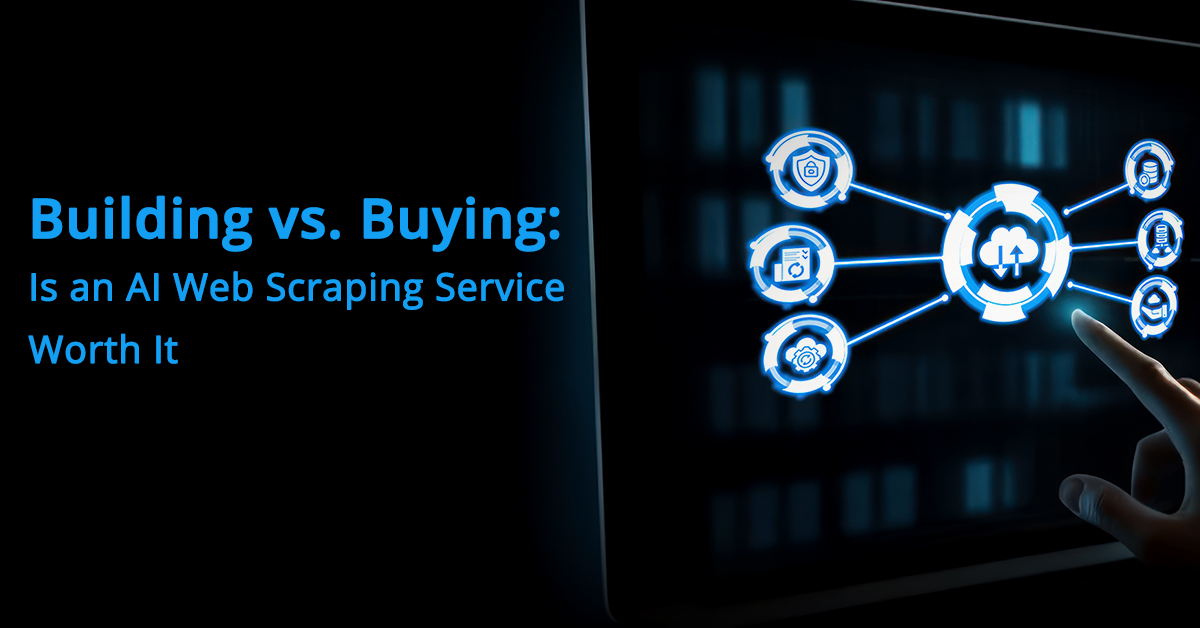
Introduction
Web scraping is the backbone of competitive intelligence, pricing intelligence, market research, and automation in the age of data-driven decision-making. Whether it is monitoring product prices, tracking competitors, collecting news, or feeding machine learning models, scraped web data is mission-critical for companies in every industry. However, as scraping grows in complexity, including AI-led extraction, anti-bot defense mechanisms, and legal scrutiny, companies face a significant question: Should they build their own AI-led web scraping infrastructure or purchase a managed scraping service? Let’s explore both in-depth, including costs, advantages, challenges, and a clear framework to help you make the correct decision.
What Is AI Web Scraping?
Historically, web scraping involved writing scripts to retrieve HTML pages and process them in some way. The modern web is no longer static, however. Many sites employ modern JavaScript frameworks, dynamic rendering, or bot protection systems like Cloudflare and CAPTCHA.
AI web scraping utilizes machine learning and natural language processing to extract structured data from these complex and ever-changing web pages. Rather than relying strictly on brittle XPath or CSS selectors, AI models can identify page layouts, recognize patterns and semantics, and even recognize visual items, such as graphs or tables.
A modern web scraping setup usually includes:
● Intelligent crawling utilizes rotating proxies, headless browsers, and advanced techniques to manage sessions effectively.
● Dynamic rendering: This helps handle websites that use JavaScript, using tools like Playwright or Puppeteer.
● AI-driven extraction: This employs natural language processing or computer vision to identify entities, fields, and relationships.
● Error management: This includes automatic retries, detecting layout changes, and correcting broken selectors.
● Data verification ensures that confidence scores are validated, eliminates duplicates, and that the data adheres to a specified structure.
● Compliance and governance refer to adhering to legal and ethical standards.
The decision to build your own system or buy one largely depends on whether you can or want to manage all these parts yourself.
Build vs. Buy: Comparing AI Web Scraping Platforms In-House vs. Managed Services
Option 1: Building an AI Web Scraping Platform In-House
The Benefits of Building Your Own
● Total Control
You have the power to dictate how, when, and what you scrape. It means that you can respond rapidly to changes in your business’s needs, tailor your extraction logic to suit your requirements, and integrate deeply with your internal processes.
● Custom AI Models
The ability to construct domain-specific models for extraction can become especially important in niche segments, such as real estate, e-commerce, and finance, where off-the-shelf models may not be sufficient.
● Security and Compliance
Your sensitive data never needs to leave your infrastructure. It enables you to enforce strict data governance, data residency, and privacy compliance in accordance with your company’s policies and regulations.
● Long-Term Cost Savings
Over time, it is likely cheaper to own the infrastructure than to pay vendors a fee for each page.
Challenges of Building
● High Engineering Costs
Building your project will require a team that includes data engineers, machine learning specialists, DevOps experts, and lawyers. Maintaining proxies, headless browsers, and models can be a challenging task.
● Time-to-Value
A stable production-quality scraper can take months to develop. If your goal is speed, this can be an expensive delay.
● Maintenance Overhead
Websites frequently change their appearance. Your team will invest considerable time in “selector babysitting”, fixing broken crawlers, and implementing updates to changes in anti-bot strategy.
● AI Complexity
Fine-tuning prompts, minimizing hallucinations, and versioning models require expertise in ongoing machine learning operations (MLOps).
| Cost Category | Estimated Cost |
| Engineering (2–3 developers) | $400K–$550K |
| Proxy and Infrastructure | $150K–$250K |
| AI Model & API Costs | $50K–$100K |
| Compliance & Legal | $25K–$50K |
| Total (approx.) | $650K–$950K |
Example Cost Breakdown (Year 1) If scraping is core to your business and you plan to scale massively, these upfront costs may pay off over time. But for many startups or mid-sized companies, this can be a significant investment.
Option 2: Buying an AI Web Scraping Service
You can choose a fully managed web scraping service. Some options are iWeb Scraping, Scraping Intelligence, X-Byte, Zyte, Bright Data, ScraperAPI, Diffbot, SerpApi, and Web Screen Scraping. These companies manage the entire pipeline, including crawling, rendering, AI Data Extraction, and delivery in a structured manner, via APIs or downloadable formats such as JSON, CSV, or database outputs. These companies provide AI-enabled parsing and large-scale infrastructure, enabling businesses to utilize trustworthy, ready-to-use data sources without requiring in-house proxies, browser automation, or anti-bot systems.
Advantages of Buying
● Fast Time To Market
Collect your data in just days instead of months because these vendors are already managing the proxy farms, the browser clusters, the proxies, and the AI parsers.
● Lower Startup Costs
You are paying by data record or web page, so it is much easier to budget for and test before scaling.
● Less Maintenance
The vendor handles website changes, anti-bot updates, retries, and error management.
● Advanced Technologies
Many offer embedded data enrichment, data quality rating, duplicate removal, and data pipelines (such as JSON, CSV, or direct integration with the data warehouse).
● Scalability and Reliability
From uptime and success rates, vendors can generally guarantee a level of offerings backed up by Service Definitions and Service Level Agreements.
Typical Cost Structure
| Tier | Price per Page | Features |
| Basic | $0.005–$0.01 | Static pages, basic extraction |
| Standard | $0.01–$0.02 | JS rendering, structured JSON |
| Premium (AI-driven) | $0.02–$0.05 | Dynamic pages, AI extraction, QA |
A company scraping 50 million pages per year at $0.015 per page would spend about $750,000 annually, often cheaper than building from scratch, especially when factoring in maintenance.
The Hybrid Model: The Best of Both Worlds
Many companies maintain a hybrid approach, with their crawling infrastructure outsourced but AI extraction/post-processing handled in-house.
This hybrid approach provides:
● Dependable automation and management of proxy rotation, CAPTCHA, and rendering by the vendor.
● Customization for AI parsing, entity linking, and compliance by your in-house team.
● Faster iterations while keeping control over your key assets.
For example, the vendor offers raw HTML snapshots or screenshots, whereas your in-house models focus on extracting specific information, such as specifications, prices, or product names.
What Are The Legal, Ethical, and Compliance Considerations?
It is essential to understand and adhere to the legal limitations when scraping a website. The laws vary by country, and ignoring them can lead to penalties and damage to the brand.
Some good practices consist of the following:
● Follow Robots.txt and TOS. While it may physically be possible to scrape data, it may violate TOS. Consult with legal counsel regarding potential liability.
● Avoid collecting private or sensitive information. Follow the data protection laws in your area, such as GDPR or CCPA.
● Limit the number of requests you make and stick to set rate limits. Aggressive data collectors can harm servers and may be viewed as harmful.
● Be open about your data collection. Keep a clear record of where you obtained the data, including the date and time of collection.
● Protect and anonymize data. Remove personally identifiable information and encrypt sensitive data before saving it.
Whether you build or buy, compliance should not be an afterthought. It is instead a principle of all fundamental design.
What Are The Key Factors to Consider Before Deciding?
| Factor | Build | Buy |
| Time-to-Market | Slow (months) | Fast (days/weeks) |
| Customization | Very High | Moderate |
| Upfront Cost | High | Low |
| Ongoing Maintenance | High | Low |
| Data Security | Full Control | Vendor-Dependent |
| Scalability | Depends on team | Highly Scalable |
| Long-Term Cost | Potentially Lower | Higher at Scale |
A Practical Decision Framework
Here’s a simple guide to help you decide:
Buy if:
● Results are needed quickly
● Scraping needs are moderate or project-based
● You have no in-house scraping or ML expertise
● You want predictable pricing that is pay-as-you-go.
Build if:
● Data collection is the lifeblood of your company
● You need heavy customization or specialized A.I. extraction
● You have an experienced data engineering and ML team
● You want complete control of compliance and infrastructure.
Hybrid if:
- You want to own A.I. intelligence, but outsource the plumbing.
- You wish to scale while retaining flexibility gradually.
- You want faster delivery without sacrificing strategic control.
To wrap it up
AI web scraping has evolved from a raw data collection methodology in years past to a must-have capability. Whether you build or buy, the purpose is the same: to acquire reliable, high-quality data in volume. If speed, scalability, and lower operational costs are your primary concerns, then selecting a reliable managed AI web scraping service is a sensible choice. Web data is crucial for your organization, particularly if you utilize analytics or AI models. Instead of dealing with technical issues such as proxies, CAPTCHA, and website layout changes, you can focus on transforming data into actionable insights. Building your own data platform is a wise long-term investment. It gives you more flexibility, productivity, and control.
Read More Gorod