BlitZ
BlitZ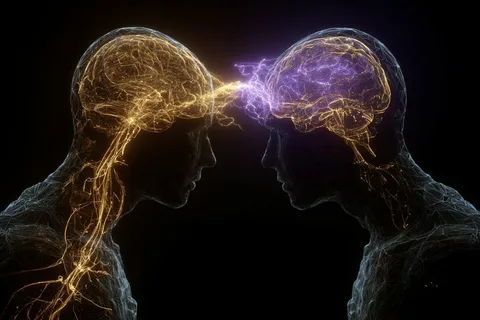
Your partner walks through the door tense and distracted after a hard day, says very little, and within twenty minutes, you are both on edge in a way neither of you can fully explain. You hadn’t had a bad day. You weren’t irritable an hour ago. Yet here you are.
What happened is called emotional contagion, the automatic and largely unconscious process by which one person’s emotional state transfers to another. Psychologists Elaine Hatfield and colleagues identified it in 1993 as a core social mechanism driven by mimicry and physiological feedback. They described “primitive emotional contagion” as the foundation on which empathic skills are built. Before complex perspective-taking develops, humans synchronize with each other through the body first, mirroring a partner’s expressions, posture, and vocal tone automatically and without intent.
Gary Tucker, Chief Clinical Officer at D’Amore Mental Health, puts it plainly. “Before we ever learn to consciously put ourselves in a partner’s shoes, our nervous systems are already doing it for us, picking up on facial expressions, tone of voice, and body language without a second thought. That automatic attunement is at the heart of what makes couples feel deeply connected, but it’s also why one person’s distress can ripple through an entire relationship so fast.”
Emotional contagion is often conflated with empathy, though the two are distinct. Empathy requires deliberate perspective-taking. Contagion operates at the level of the nervous system and bypasses conscious effort entirely. The mechanism itself is neutral. In emotionally safe relationships, it deepens attunement and bonding. In high-conflict environments, it spreads distress with equal efficiency.
What Is Happening in the Brain
When a partner displays fear, frustration, or sadness, the observer’s brain begins to simulate that same state through the mirror neuron system, which fires both when we perform an action and when we observe someone else performing it. The amygdala responds rapidly to emotional cues from a partner, often before the prefrontal cortex has had time to assess context or intent. A tense expression or a clipped tone can register as a threat before a single word has been spoken.
Inter-brain synchronization has emerged as a measurable neuromarker of emotional contagion. When partners share emotional states, overlapping activation patterns and synchronized neural oscillations appear between their brains. Hyperscanning studies, which record brain activity in both partners simultaneously, have documented this alignment in real time.
Zoe Tambling, LMFT, Clinical Director at Anchored Tides Recovery, explains what that synchronization means for couples in practice. “That biological attunement can be a powerful tool for calming each other down, but it also means that when one partner is overwhelmed, the other’s nervous system often goes right there with them.”
Couples in close relationships also develop measurable physiological coupling in heart rate variability, cortisol output, and respiratory patterns over time, extending the emotional field well beyond conscious awareness.
The Ripple Effects in Daily Life
Observing a partner’s emotional expression activates corresponding neural networks in the observer and generates automatic mimicry before any deliberate response takes shape.
Michael Anderson, LPC at Healing Pines Recovery, describes how concrete that process actually is. “Most people assume emotional contagion is something vague and invisible, but it’s actually happening at the level of facial muscles, posture, and breathing, with your body starting to mirror your partner’s before your brain has even registered what’s going on. That’s exactly why we focus on small behavioral shifts in couples work, because softening a tense expression, slowing the voice down, or uncrossing the arms can interrupt a negative loop before it escalates.”
Positive contagion runs through the same pathway. Shared laughter, warmth, and playful exchanges reinforce bonds and reduce stress. Negative contagion operates faster and tends to linger. Irritability triggers defensive arousal in the receiving partner, who generates their own irritability and feeds it back, often completely detached from the original stressor.
A 2024 review on asymmetric emotional contagion found that emotional influence within a couple is frequently unequal. Kevin Belcastro, LMFT, Clinical Director at San Diego Transformation Center, sees the same dynamic in his clinical work. “Emotional influence in a relationship rarely splits down the middle, and in most couples, one person’s stress, anger, or calm tends to set the emotional temperature for the whole household without anyone realizing it. Understanding who’s driving the emotional climate and why is one of the most eye-opening conversations I have with clients, because it opens up honest questions about emotional labor, burnout, and what it would actually look like to share that weight more evenly.”
How Contagion Fuels Conflict
John Gottman’s concept of negative affect reciprocity describes what happens when emotional contagion enters a conflict cycle. One partner’s negativity activates the other’s, which returns to the first with added intensity. Contempt, defensiveness, and withdrawal spread through mirroring before either person has consciously decided to escalate. A minor irritation can grow into a significant argument because emotional mimicry amplifies the original signal at every exchange.
When a partner recognizes that their current emotional state may be absorbed rather than independently generated, there is a moment of choice before the reaction completes. That recognition is often the most direct interruption available.
Regulation, Both Solo and Together
How each person manages their own emotional state shapes the shared emotional environment. Cognitive reappraisal, which involves consciously reframing the meaning of a situation, tends to interrupt contagion loops more effectively than suppression. Suppression frequently intensifies internal arousal while concealing its expression, delaying dysregulation without resolving it.
Secure attachment brings a structural advantage. A partner who stays grounded under stress actively stabilizes the dyad. Introducing warmth, humor, or physical affection during a tense moment seeds positive contagion using the same pathway that negative affect would otherwise travel.
Where the Science Is Still Catching Up
Longitudinal couple studies on emotional contagion remain scarce, and much of the existing data comes from controlled lab settings that only partially replicate real relationship life. Cultural variation in emotional expressivity is largely unexamined. Digital communication introduces a further complication, as text-based emotional cues operate through a narrower bandwidth than vocal and facial expression, and how contagion propagates across screens remains an open question.
What is already clear is that in close relationships, emotional states do not stay contained within the person experiencing them. They move. Couples who understand that dynamic have a more accurate map of what is actually happening between them during stress, conflict, and repair.