BlitZ
BlitZ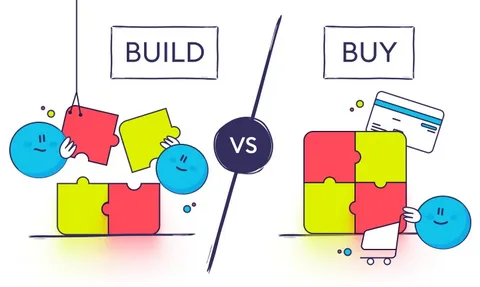
Every business eventually faces the same question. We need a tool that does not exist. Do we buy something off the shelf, build it from scratch, or find a middle ground?
This decision used to be binary. You either purchased a SaaS product and adapted your workflow to fit it, or you hired developers and built exactly what you needed. Both paths had well-known tradeoffs. Buy was faster but less flexible. Build was flexible but slower and more expensive.
No-code platforms have created a third option that changes the calculus entirely. But choosing correctly still requires understanding what each path actually costs, not just in dollars, but in time, risk, and organizational energy.
The Case for Buying Off-the-Shelf Software
SaaS products exist for almost every business function. Project management, CRM, invoicing, scheduling, inventory, communication. The category leaders in each space have invested millions in building polished, feature-rich products.
Buying makes sense in specific situations.
- The problem is generic and well-defined. If your need matches exactly what the product does, buying is the fastest path to a working solution. Accounting software is a clear example. Payroll processing is another. These are domains where the rules are standardized and customization creates more risk than value.
- Speed is the primary constraint. A SaaS product can be up and running in hours or days. If the business cannot afford to wait weeks for a custom solution, buying provides immediate relief even if the fit is imperfect.
- The vendor’s roadmap aligns with your needs. If the product is actively developed and the vendor is investing in features that matter to your business, buying gives you continuous improvement without additional cost.
But buying fails in predictable ways.
- Feature gaps force workarounds. The product does 80% of what you need. The remaining 20% requires manual processes, data exports, or third-party integrations that introduce fragility. That 20% gap often represents the most important part of your workflow.
- Data portability is limited. Your business data lives in someone else’s system, structured in their data model, accessible through their API. If you outgrow the product or the vendor raises prices or shuts down, extracting your data and migrating to an alternative is a project in itself.
- Per-user pricing accumulates. A tool that costs $30 per user per month sounds reasonable for a ten-person team. At 200 users, that same tool costs $72,000 per year. At 500 users, it is $180,000 annually. For a tool that still does not do exactly what you need.
- Customization is constrained by the vendor’s priorities. You can submit feature requests, but you are one of thousands of customers. The features that matter most to your specific workflow may never be built because they do not serve the broader market.
The Case for Building Custom Software
Custom software gives you exactly what you specify. Every screen, every workflow, every data field matches your requirements. For companies with truly unique processes or strict regulatory requirements, custom development can be the right choice.
Building makes sense in specific situations.
- Your competitive advantage depends on the tool. If the software itself is your product or if it enables a process that differentiates you from competitors, building creates defensible value that a generic tool cannot provide.
- Integration requirements are complex and non-standard. When the application needs to communicate with legacy systems, proprietary hardware, or industry-specific platforms that have limited API support, custom development may be the only path.
- Regulatory requirements demand specific data handling. Industries like healthcare, finance, and defense sometimes require data residency, encryption standards, or audit capabilities that off-the-shelf products do not support.
But building carries costs that are easy to underestimate.
- Development timelines are notoriously unreliable. Software estimation is one of the hardest problems in the industry. Projects routinely take two to three times longer than initial estimates because complexity reveals itself progressively, not upfront.
- Ongoing maintenance is a permanent cost. Custom software requires security patches, bug fixes, infrastructure management, and feature updates for as long as the business uses it. The development team that built the application needs to remain available indefinitely, which often means a permanent headcount commitment.
- Technical debt accumulates from day one. Every shortcut taken to meet a deadline, every feature added without refactoring, every integration patched together under time pressure becomes a liability that makes future changes slower and more expensive.
- Talent dependency creates organizational risk. The developers who built the system hold institutional knowledge that is difficult to transfer. If they leave the company, the remaining team inherits a codebase they may not fully understand.
The No-Code Middle Path
No-code platforms offer a combination of benefits that neither buying nor building provides on its own.
- Speed comparable to buying. A no-code application can move from concept to working prototype in days. Full deployment with integrations and role-based access typically takes weeks, not months.
- Customization comparable to building. The application matches your workflow because it was built specifically for your workflow. Every screen, every form, every data relationship reflects how your business actually operates.
- Cost dramatically lower than building. No-code platforms eliminate the need for custom hosting, infrastructure management, and most of the security overhead that custom development requires. Development time is shorter because the platform provides pre-built components for common functionality.
- Maintenance is shared with the platform. The no-code provider handles hosting, uptime, security patches, and platform updates. Your team focuses on business logic and workflow improvements rather than infrastructure management.
The limitation of no-code is that it requires the right platform and the right expertise to produce enterprise-grade results. A simple data collection app can be built by anyone. A production application that handles SSO, connects to external databases, processes complex business logic, and serves hundreds of concurrent users requires experienced builders.
This is where working with a specialized agency delivers outsized value. A team like Glide App Agency operates at the intersection of platform expertise and business knowledge. They have built over 350 applications for companies ranging from startups to Fortune 500 enterprises, which means they understand not just what the platform can do, but what it should do for a specific business context.
A Decision Framework
Choosing between buy, build, and no-code requires evaluating your situation across several dimensions.
How unique is your workflow? If your process matches a common pattern, buying is likely sufficient. If your process has significant custom elements but follows a generally standard structure, no-code is the sweet spot. If your process is entirely novel with no existing analogues, custom development may be necessary.
What is your timeline? If you need a solution this week, buy something and plan to replace it later. If you need a solution this quarter, no-code delivers the best combination of speed and quality. If you have six to twelve months and the budget to match, custom development is an option.
What is your budget? SaaS products have the lowest upfront cost but the highest long-term per-user cost. No-code projects have moderate upfront cost and low ongoing cost. Custom development has the highest upfront cost and significant ongoing maintenance expense.
How important is iteration speed? Businesses that need to modify their tools frequently benefit enormously from no-code. Changes that take weeks in custom software take days or hours on a no-code platform. SaaS products offer the least flexibility for modification.
What integrations do you need? Modern no-code platforms support API integrations with most major business systems. If your integration needs are standard, no-code handles them well. If you need to integrate with proprietary or legacy systems that lack APIs, custom development may be required.
Common Mistakes to Avoid
Companies make predictable errors when evaluating these three paths.
- Overestimating the uniqueness of their workflow. Most businesses believe their processes are more unique than they actually are. The core patterns of inventory management, field service, CRM, and project tracking are remarkably consistent across industries. The variations that matter can usually be accommodated through configuration rather than custom code.
- Underestimating the total cost of ownership for custom software. The development budget is the beginning, not the end. Hosting, monitoring, security, bug fixes, and feature updates add ongoing costs that often exceed the original development investment within two years.
- Choosing based on current size rather than projected growth. A tool that works for twenty users needs to work for two hundred users in two years. Evaluating solutions based on current needs rather than near-term growth leads to painful migrations that could have been avoided.
- Going with a generalist agency when a specialist is available. A Glide agency that has spent years building on a single platform will produce better results faster than a general development shop that treats no-code as one of many tools in their portfolio. Platform depth matters more than platform breadth.
Making Your Decision
The right choice depends on your specific situation, but a useful starting principle is this: default to the simplest solution that meets your requirements.
If an off-the-shelf product does 95% of what you need, buy it. If your needs are genuinely custom but your processes follow standard business patterns, build on a no-code platform with experienced partners. If your requirements are truly novel and cannot be approximated by any existing platform, build custom software.
Most companies that evaluate honestly find themselves in the middle category. Their processes are custom enough to need a purpose-built tool but standard enough to be served by a well-architected no-code application. That is the sweet spot where the best return on investment lives.