World rankers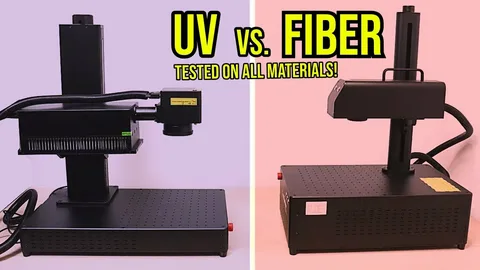
In industrial marking, the laser marking machine is now an important tool for metal processing. It is widely used for part marking, product identification, serial numbers, and QR codes on metal products.
Many customers ask the same question when choosing a machine:
If the material is metal, which laser marking machine is the best choice?
To choose the right laser marking machine for metal, it is important to understand how laser marking machines are classified and how different laser wavelengths interact with metal materials.
The following content is based on Hantencnc’s practical experience in metal laser marking applications.
1. Common Laser Wavelengths and Types of Laser Marking Machines
According to different laser wavelengths, laser marking machines can be divided into the following types:
- Fiber laser marking machine (1064nm)
- CO₂ laser marking machine (10640nm)
- Green laser marking machine (532nm)
- Blue laser marking machine (450nm)
- UV laser marking machine (355nm)
Different wavelengths are designed for different materials. For metal marking, choosing the correct wavelength is very important for stable and clear marking results.

2. Why Are There So Many Laser Wavelengths?
Laser marking machines are used on many kinds of materials. These include metal materials such as gold, silver, copper, iron, aluminum, and stainless steel. They are also used on non-metal materials like plastic, glass, ceramic, rubber, and wood.
Different materials absorb laser light in different ways. To get accurate and stable marking results, different laser wavelengths are needed to match different materials.
Here is a common example in metal laser marking:
Stainless steel can absorb about 30%–45% of 1064nm fiber laser energy.
But it absorbs only about 5%–10% of 10640nm CO₂ laser energy.
When a material absorbs more laser energy, the marking result is clearer and more stable. This is why one laser marking machine cannot be suitable for all materials, especially for metal marking applications.

3. Laser Types Used for Metal Marking
In metal laser marking applications, the most commonly used laser sources are fiber laser and UV laser.
Both fiber laser and UV laser can be used for metal marking, but their working principles are very different.
Fiber laser has low photon energy. It cannot directly remove metal atoms or molecules. Instead, it focuses high energy on the metal surface, heats it very quickly, melts and vaporizes the surface, and forms marking lines through heat diffusion. This process happens in a very short time, usually only a few milliseconds. This method is often called “thermal processing.”
UV laser has a wavelength of 355nm and very high photon energy. It can directly break the chemical bonds on the metal surface. It does not rely much on high-temperature vaporization. After marking, the material surface has very little heat effect. This is why UV laser is often called a “cold light source.”
The terms “hot” and “cold” are common industry names, not strict scientific definitions.

4. Difference Between Fiber Laser and UV Laser for Metal Marking
When marking thin metal sheets, higher heat means a higher risk of material deformation after marking.
From a theoretical point of view, UV laser has higher absorption and a smaller heat-affected area on metal. So many people think UV laser should be better for metal marking.
But is this always true in real applications?
When choosing a laser marking machine, we must consider not only theory, but also price, power, service life, marking speed, and maintenance cost. Below is a comparison of fiber laser and UV laser in metal marking.
1. Fiber Laser: Typical Thermal Processing
Fiber laser has lower photon energy and cannot directly break chemical bonds on the metal surface. It works by focusing high energy in a short time to heat, melt, and vaporize the metal surface. The marking pattern is formed through heat diffusion.
This method is very stable for common industrial metals such as stainless steel, carbon steel, and aluminum alloys.
2. UV Laser: Near Cold Processing
UV laser has very high photon energy and can directly damage the material structure. During UV laser marking, the process does not depend much on high temperature. The heat effect on the material surface is very small.
This makes UV laser suitable for applications that are sensitive to heat.

5. Key Differences Between Fiber Laser and UV Laser
1. Power Comparison
UV laser marking machines usually have a power range of 3–20W.
Fiber laser marking machines usually have a power range of 20–300W.
In metal marking, laser power directly affects marking speed and engraving depth. In the same working time, fiber laser can mark metal faster and deeper than UV laser.
2. Price Factor
A 3W UV laser marking machine usually costs around USD 5,000–7,000.
With the same budget, it is possible to buy a 50W or higher power fiber laser marking machine.
From a cost-performance point of view, fiber laser is more economical for metal marking.
3. Service Life and Maintenance
The service life of a UV laser source is usually around 8,000–10,000 hours. It requires a clean working environment. Dust on optical parts can reduce power or damage the laser.
Fiber laser sources usually have a service life of 80,000–100,000 hours. They use a sealed design and can work stably in normal industrial environments.
4. Marking Efficiency and Results
Although UV laser has higher absorption on metal surfaces, its power is limited. For deep engraving, high-speed marking, and mass production, fiber laser has clear advantages in efficiency and stability.

6. Fiber Laser Is Still the Main Choice for Metal Marking
Based on absorption, power, service life, price, and maintenance cost, we can reach a clear conclusion:
For metal marking applications, fiber laser marking machines are still the most mature, stable, and cost-effective solution.
Although metals absorb UV laser better, UV laser is limited by power and service life. It is not suitable for deep metal engraving or large-scale industrial production.

7. Applications Where UV Laser Marking Is More Suitable
UV laser marking machines are not “weak.” They are simply not designed mainly for deep metal marking.
UV lasers work very well on materials such as glass, crystal, ceramic, plastic, and thin films. They can achieve high precision with very low heat damage. These are applications where fiber lasers are often not suitable.
For multi-material marking and high-precision applications with strict heat control, UV laser marking machines are still irreplaceable.